One of the goals of the Oracle Mobile Cloud Service (MCS) is to be client agnostic. So, you should be able to connect to your MCS hosted mobile backend from any client technology out there.
If you are a JavaScript developer you might be familiar with the very popular Ionic Framework.
Now, if you want to use an Ionic-based mobile app with the Oracle Mobile Cloud Service backend we have created a starter project for you that will show you how to perform the basic tasks and get you going in no time.
Have a look or clone the following GIT repo: https://github.com/mjabali/ionic-starter-mcs
The Readme file provides the instructions on how to get started with this sample.
Have fun!
Showing posts with label mobile development. Show all posts
Showing posts with label mobile development. Show all posts
Wednesday, November 4, 2015
Monday, October 12, 2015
Getting Started with Oracle Enterprise Pack for Eclipse and Mobile Cloud Service APIs
There is a recent uploaded Oracle Mobile Cloud Service (MCS) tutorial that walks you through the process of connecting Oracle Enterprise Pack for Eclipse (OEPE) to the MCS APIs.
There are 6 steps involved on this tutorial and you will:
There are 6 steps involved on this tutorial and you will:
- Start Eclipse and configure it to work with Oracle Mobile Application Framework (MAF)
- Create a new mobile application, a new feature and a page to hold data
- Connect the MAF-based application to an MCS instance
- Generate the Java classes to support the exposed MCS REST API
- Develop a new page by adding data and security settings
- Package, deploy and test the application
The tutorial can be accessed here: http://docs.oracle.com/cd/E65774_01/tutorials/tut_mcs_oepe/tut_mcs_oepe_1.html
Enjoy!

Monday, June 22, 2015
Oracle Mobile Cloud Services - Mobile Application Accelerator (MAX) Demo
To satisfy the many, many enterprise use cases for
mobility we need a new way to satisfy the demand without having to involve a
mobile app development project.For many, the answer lies in
giving business-side workers the ability to mobilize their own business
processes. To address this requirement, Oracle is announcing the preview of
Mobile Application Accelerator (MAX) , a new capability in Oracle Mobile Cloud
Service. MAX is a cloud-based offering that brings mobile application
development capabilities to professionals with no previous software development
experience. With MAX, program managers, power users, and business professionals
can develop mobile applications quickly and visually through their web browser.
Here are a few highlights of the Mobile Application Accelerator (MAX):
- Browser based development
- No coding required
- Easily map to business services
- App Preview
- Edit, Test and Publish from the web browser
Wednesday, February 4, 2015
Redirecting the log file in the Oracle Mobile Application Framework
If you have been developing with the Oracle Mobile Application Framework you already know that's not always easy to get debugging information out of the iOS Simulator or the Android Emulator.
When you are running on the iOS Simulator you can now use the -consoleRedirect option and send the logging information to an easier location to find. Although you can do that in Apple's XCode, doing that in JDeveloper is quite straightforward.
Open up your MAF project in JDeveloper, select Run >>> Choose Active Run Configuration >>> Manage Run Configurations

Then, click Edit and select the Mobile Run Configuration
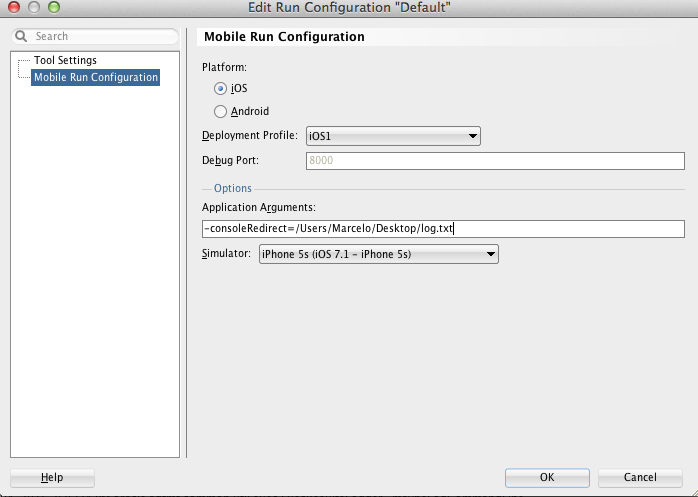
Add the -consoleRedirect=<Any_File_You_Want> and select the Simulator configuration (if you have multiple ones configured). Click OK.
You can now use the JDeveloper Run button (the little green triangle on the top menu) that will launch and run your app (you must use this approach to redirect the log file - that's a limitation but worth the price).
This has been tested with the Oracle Mobile Application Framework 2.1.
Happy Debugging!
When you are running on the iOS Simulator you can now use the -consoleRedirect option and send the logging information to an easier location to find. Although you can do that in Apple's XCode, doing that in JDeveloper is quite straightforward.
Open up your MAF project in JDeveloper, select Run >>> Choose Active Run Configuration >>> Manage Run Configurations
Then, click Edit and select the Mobile Run Configuration
Add the -consoleRedirect=<Any_File_You_Want> and select the Simulator configuration (if you have multiple ones configured). Click OK.
You can now use the JDeveloper Run button (the little green triangle on the top menu) that will launch and run your app (you must use this approach to redirect the log file - that's a limitation but worth the price).
This has been tested with the Oracle Mobile Application Framework 2.1.
Happy Debugging!
Monday, January 19, 2015
Oracle Mobile Application Framework Getting Started Demo
Sometimes you just need a little push to get started on something and this is pretty much the goal of this post... to get you started with the Oracle Mobile Application Framework.
I'm a very visual person and no matter how much I read about a specific topic I prefer watching a demo or a tutorial and then I try to do something on my own.
With that idea in mind I recorded a 3-part Oracle MAF demo that covers how to get started developing a mobile app, create a new feature (module), create and customize a task flow, invoke a REST Web Service as well as a SOAP Web Service, customize the request and response for the Web Service calls, create a data control, customize the MAF AMX pages, import a local HTML resource, configure a Remote URL based feature and deploy to the iOS Simulator.
I hope you enjoy!
Part 1: Getting Started with Oracle Mobile Application Framework
Part 2: Getting Started with Oracle Mobile Application Framework
Part 3: Getting Started with Oracle Mobile Application Framework
You can also watch these videos directly on Youtube: https://www.youtube.com/watch?v=KZ3xZDDDFwc&list=PLgz4ntw9X2fG_umbS1GcSIHZJs1jheUM_
Tuesday, December 16, 2014
How to dial a phone number from Oracle Mobile Application Framework?
Sometimes you need to dial a number from within a mobile app and for my surprise that functionality was not directly exposed through the Oracle Mobile Application Framework APIs.
Oracle MAF provides a component called Link (Go) available under the General Controls palette that can be used for navigation between pages but it can also be used to enable linking to external URLs.
Using the tel: URL scheme with the Link (Go) component gives you the capability to dial phone numbers from within an Oracle Mobile Application Framework app.
So, here is how to do it:
On your MAF page, drag and drop a Link (Go) to the Panel Page and then set the URL in the component properties to the desired phone number. You can also use a Managed Bean to set the value if you want to do some processing before displaying the number to be called.
 |
| MAF Page source code after adding a Link (Go) component |
 |
| Link (Go) component property panel |
If you have mixed UI content on your Oracle MAF app and you want to get the same behavior on a HTML page you just need to add the following on your source code:
<a href="tel:+1-800-555-1234">call this number</a>
Wednesday, October 22, 2014
New Oracle Mobile Application Framework (MAF) Academy Course
If you want to get into mobile application development with Oracle Mobile Application Framework (MAF), there is a new Oracle Developer Academy course available for you.
This new course includes an introduction to the Mobile Application Framework and teaches you how to design a MAF-based application, integrate with device capabilities, how to develop with web services and how to secure a MAF application.
In this FREE two-hour interactive online course you'll learn and master the design, architecture, interoperability and security of Oracle Mobile Application Framework based applications.
Hurry up and get yourself educated on the Oracle mobile application development framework.
Here is the link to the course: http://bit.ly/MAFCourse
Have fun!
Thursday, October 9, 2014
Working with Device Information in the Oracle Mobile Application Framework
With the proliferation of new device models, form factors and operating systems, you may be thinking about the challenges to make your application work handle all of these different device properties information as there may be features that rely on specific characteristics or capabilities.
As an example, how frustrating it would be for the user trying to use a mapping feature if the device doesn't support geolocation? Or, just getting the device screen height and width to make sure the content fits nicely and also dynamically present different things on the smaller / larger real state you have available. As a developer, it's your responsibility to make sure everything works and looks good on all devices (even though this is a hard task).
The Oracle Mobile Application Framework (MAF) utilizes Apache Cordova to provide access to device properties, SMS, Email, Contacts, Camera, Pictures/Photo Library, Geolocation, Accelerometer, Network, etc. that can either be accessed from Java, JavaScript and Expression Languages in order to support these requirements on your mobile application.
Additionally, the most common functionality (sendEmail, getPicture, createContact, sendSMS, etc) is exposed as a Data Control and can be simply dragged-and-dropped onto an AMX page reducing the need for coding calls to the API and constructing the necessary screens.
The MAF documentation covers all in details but here is a list of what's currently supported by the framework (through the embedded Apache Cordova API):
- device.name
- device.platform
- device.version
- device.os
- device.model
- device.phonegap
- hardware.hasCamera
- hardware.hasContacts
- hardware.hasTouchScreen
- hardware.hasGeolocation
- hardware.hasAccelerometer
- hardware.hasCompass
- hardware.hasFileAccess
- hardware.hasLocalStorage
- hardware.hasMediaPlayer
- hardware.hasMediaRecorder
- hardware.networkStatus
- hardware.screen.width
- hardware.screen.height
- hardware.screen.availableWidth
- hardware.screen.availableHeight
- hardware.screen.dpi
- hardware.screen.diagonalSize
- hardware.screen.scaleFactor
Most of the property names are self-explanatory and I won't go into the details of each one of them but there is a demo available for you that shows how to get started and use some of the information that the framework provides. Screenshots on both platforms are available below so you can take a peek what it looks like:
 |
| iOS Simulator |
 |
| Android Emulator |
In summary, integrating the device features into a Oracle MAF application is easy and flexible, the declarative drag and drop support suits most of the use cases and you can get deeper control programatically.
The source code is available here: https://github.com/mjabali/DeviceFeatures
Have fun!
Subscribe to:
Posts (Atom)
Setting Up Local Environment for Developing Oracle Intelligent Bots Custom Components
Oh the joy of having a local development environment is priceless. For most cloud based solutions the story repeats itself being hard to tr...
-
 There are some use cases and business scenarios where you have to process messages in order. Basically, when multiple consumers receive mes...
 -
 Apache ActiveMQ / FUSE Message Broker has a feature called Virtual Destinations that are logical destinations (queues or topics) mapped t...
 -
 For several times I wondered what was the exact time my machine booted, woke up or slept. So, I did a little investigation to find out tha...